 WATCH VIDEO!
 WATCH VIDEO!
As of July 1, 2026, HB402 is officially in effect. If you’ve been sitting on a killer pickle recipe or dreaming of turning your kitchen into a small business, this is the moment. The new law removes some of the biggest roadblocks that used to hold sellers back.
Starting is genuinely simple. Here’s the short version:
- Pick your foods from the allowed categories listed below.
- Check your local city or county office to see if a business license is required. Just call the main number and ask.
- Make your labels (see the label section for exact requirements).
- Start cooking, marketing, and selling.
Virginia gives you two ways to sell your homemade products. The cottage food exemption is the fast, no-fee route for certain foods. The home food processing permit is the broader route if you want to sell perishable items. We’ll cover both.
Table of Contents
HOW TO START YOUR COTTAGE FOOD BUSINESS IN VIRGINIA – LICENSING
To start your cottage food business in Virginia, simply follow the steps below:
STEPS TO START
Always contact your local city / county office and verify if a business license is required prior to starting.
This is simply done by calling the main number to your city and letting them know you are starting a cottage food business and ask if you need a business license.
- Pick foods to offer from the “allowed” food types listed below.
- Get a local business license in your City/County – if required
- Get labels made (see label example and requirement below)
- Start baking/cooking, marketing and selling
The One Law Behind It All
Virginia’s home food sales run through § 3.2-5130 of the Code of Virginia, administered by the Virginia Department of Agriculture and Consumer Services (VDACS). HB402 amended this statute and added a brand-new section, creating the home food processing permit pathway.
Normally, any home that manufactures, processes, packs, or holds food for sale counts as a food establishment, which means routine inspections and fees. But the law carves out exemptions that let qualifying sellers skip both.
Those three exemption categories are:
- Low Risk Foods
- Acidified Foods
- Honey Processing
Each one has its own list of allowed products and its own limits. Let’s take them one at a time.
Category 1: Low Risk Foods
These are the shelf-stable, don’t-need-refrigeration foods most people picture when they think “homemade goods for sale.”
✅ What You Can Sell
- Candies
- Jams and jellies (that aren’t low-acid or acidified low-acid products)
- Dried fruits
- Dried herbs
- Dry seasonings
- Dry mixtures
- Coated and uncoated nuts
- Vinegars and flavored vinegars
- Popcorn and popcorn balls
- Cotton candy
- Dried pasta
- Dry baking mixes
- Roasted coffee
- Dried tea
- Cereals
- Trail mixes
- Granola
- Baked goods that don’t require time or temperature control after preparation
Where You Make Them
You must prepare the food in your own private home. No rented commercial kitchens or shared community kitchens.
💡 A note on baked goods: The magic phrase is “does not require time or temperature control after preparation.” Cookies, breads, and many pastries qualify. But anything that needs refrigeration to stay safe — think cream-filled or custard-based items — falls outside this exemption.
Category 2: Acidified Foods
Love making pickles or salsa? The Virginia cottage food law just made it easier to sell them!
✅ What You Can Sell
- Pickles with an equilibrium pH of 4.6 or lower
- Acidified vegetables with an equilibrium pH of 4.6 or lower, including pickled products, salsa, chow-chow, relishes, and similar vegetables
No Sales Cap
As of July 1, 2026, there is no sales cap on acidified foods. You can grow your pickle business as far as demand will take you, as long as you keep following the safety and labeling rules.
The pH Testing Requirement
Because acidified foods carry a real botulism risk, pH isn’t optional guesswork. Your product’s equilibrium pH must be 4.6 or lower to inhibit the bacteria that cause botulism.
A few essentials:
- Buy an electronic pH meter. Pocket-sized units run around $100. Paper test strips are not accurate enough for home-processed foods.
- Test equilibrium pH, not just the brine. The acid needs time to distribute evenly. For foods processed less than two months, finely grind a sample in a blender before testing. For foods processed more than two months ago, testing the brine is acceptable since the contents should be in equilibrium.
- Test each product separately. A different product means a different pH test.
- Follow the same recipe every batch. Consistency is what keeps your product safe.
⚠️ Get expert eyes on your process. VDACS strongly advises having your process reviewed by a competent process authority, and encourages completing a recognized Better Process Control School course. When you’re working with botulism risk, this isn’t a corner to cut.
Category 3: Honey Processing
If you keep your own hives, this exemption is refreshingly simple.
The Criteria
- You process and prepare pure honey from your own hives in your private home
- You sell less than 250 gallons of honey annually
- You don’t process and sell other foods beyond what the low-risk and acidified exemptions already allow
What Doesn’t Qualify
Infused honey products don’t make the cut. Once you add flavorings, it becomes a value-added product rather than pure honey and it falls outside this exemption.
Pure honey currently has no restrictions on where you can sell it or who you can sell it to. That’s a meaningful perk for beekeepers.
Online, Phone, and In Person Sales
As of July 1, 2026, exempt sellers of low-risk foods and acidified foods can sell:
- In person at any location
- Through the internet
- By phone
And you can deliver those products:
- In person
- Through an agency
- By mail
That’s a genuine game-changer. You can now take an order online, accept it by phone, and mail it to your customer — all fully within the exemption.
Where You Can Sell
For low-risk and acidified foods, you can now sell:
- In person at any location, or
- Through the internet or by phone, with delivery in person, through an agency, or by mail
Sales still go to an individual for their own consumption but that individual can now be reached far more easily than before.
Resale and Third-Party Vendors Are Now Allowed
Another major update: you can now sell your exempt low-risk and acidified foods for resale or consignment through a third-party vendor, as long as that vendor:
- Displays your products separately from a licensed food establishment’s food, and
- Clearly indicates the required label information (your name, address, phone, process date, and the “NOT FOR RESALE” statement)
This opens the door to retail-style opportunities that Virginia’s old rules flatly prohibited.
Labeling Requirements
Every product package must display this information on the principal display panel:
- Your name, physical address, and telephone number
- The date the product was processed
- This exact statement:
“NOT FOR RESALE — PROCESSED AND PREPARED WITHOUT STATE INSPECTION”
On top of that, standard labeling still applies: the product name, net weight statement, manufacturer’s name and address, ingredient list (with subingredients), and possibly nutritional information.
A couple of practical notes:
- If your product is too small for a readable label, or is sold to be eaten on-site, a sign at the point of sale can substitute for the label.
- Honey has its own required statement: “PROCESSED AND PREPARED WITHOUT STATE INSPECTION. WARNING: Do Not Feed Honey to Infants Under One Year Old.”
No Registration, No Fee, No Inspection
Here’s the encouraging part. If you operate within one of these exemptions, you are not subject to VDACS’s periodic inspections, and you do not owe the $40 annual fee.
You still have to comply with all applicable food laws and regulations — the exemption removes routine inspection, not your responsibility for safe food. And if you ever receive a bill from VDACS for the annual fee by mistake, call them at 804-786-3520 or email [email protected] to sort it out.
The New Home Food Processing Permit Pathway
Here’s where HB402 really widens the road. The new § 3.2-5130.1 creates a permitted home food processing operator category — designed for people who want to make more than the exemption allows.
A home food processing operator is a food manufacturer who prepares, processes, or stores food for sale in a private residence that is their primary home.
What You Can Make
With a permit, you can produce, store, and sell any food — including perishable foods that require time or temperature control — as long as you meet the safety requirements:
- Keep temperature-sensitive foods at safe temperatures during preparation, storage, and distribution.
- Follow VDACS regulations for specialized processes like acidification, reduced-oxygen packaging, or curing.
- Keep records that demonstrate compliance if the Commissioner asks.
Relaxed Kitchen Requirements
This is the part home cooks will love. Under the new law, VDACS cannot require a permitted home food processing operator to:
- Submit a pre-operational plan review
- Obtain zoning approval as a permit condition
- Submit equipment certification
- Meet commercial-grade structural, plumbing, ventilation, or equipment standards beyond those of a private residence
- Remodel the home or install commercial-grade appliances
In other words, you don’t have to convert your kitchen into a commercial facility to get permitted. You do need an initial inspection to receive your permit, and VDACS may still inspect afterward to investigate complaints or verify compliance.
Local Rules Just Got Simpler
You should still check on local business licensing and standard zoning, and confirm any HOA or lease restrictions if they apply to you.
But HB402 added an important protection: no locality can adopt or enforce any ordinance, zoning rule, or regulation that conflicts with — or effectively prohibits — cottage food activity that state law authorizes. That applies to both permitted home food processing operators and exempt sellers.
So while general zoning still exists, local governments can no longer use it to block what Virginia law expressly allows.
If you operate within one of the three exemptions, you are not subject to VDACS’s routine inspections, and you do not owe the annual inspection fee.
You still must comply with all applicable food safety laws — the exemption removes routine inspection, not your responsibility for safe food. VDACS can still inspect in response to a consumer complaint.
Real Life Cottage Food Entrepreneurs and Opportunities
- Cakes – teacher turns kitchen into bakery
- Doughnuts – cottage mini donut vendor
- Fruit jams and jellies – additional information here
- Kettle corn – real kettle corn vendors from home
- Popcorn (plain and flavored) – see a real home vendor here
- Talk and Join hundreds of others here: VendorsUnited.com
COTTAGE FOOD LABEL EXAMPLE
Below is an example label:
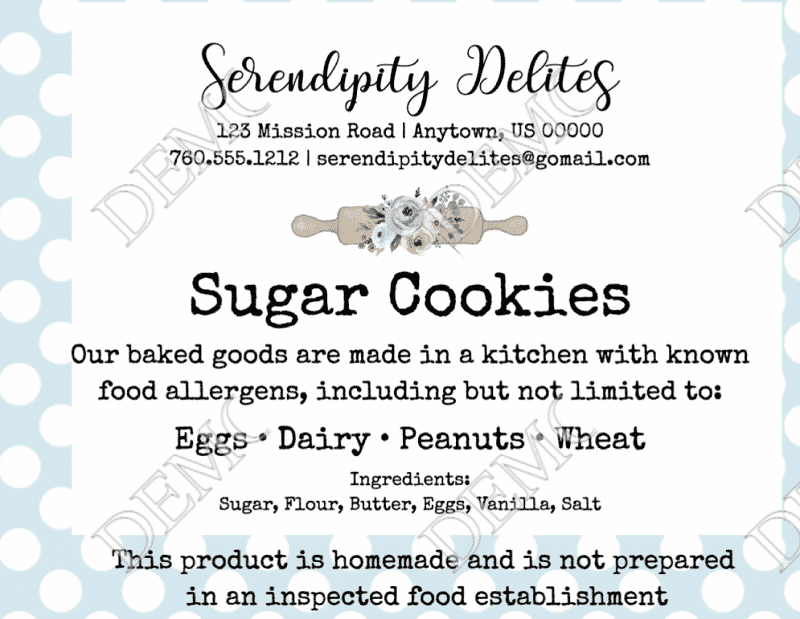
Using VistaPrint.com or similar – you can quickly create professional labels that not only serve to meet the state cottage food guidelines but also serve for marketing your awesome business and products.
You’ll find some fantastic examples of this from members inside VendorsUnited.com
ALLERGENS ON LABELING
The FDA lists nine (9) major food allergens. Listing any of these on your label is a smart business practice and will certainly help your customers choose a product.
- Milk
- Eggs
- Fish (e.g., bass, flounder, cod)
- Crustacean shellfish (e.g., crab, lobster, shrimp)
- Tree nuts (e.g., almonds, walnuts, pecans)
- Peanuts
- Wheat
- Soybeans
- Sesame seeds
Simply add to your label: “CONTAINS: SOYBEANS” Some go as far to announce that a certain allergen is used in the same kitchen.
Some states require you list any potential allergens and potential for any cross contamination even if the allergen is not used in the recipe.
FDA Allergen Labeling Example: Contains Wheat, Milk, Egg, and Soy
Inside kitchenincome.com you can find out how many cottage food entrepreneurs are getting sales faster than they can make the food.
FOOD HANDLER TRAINING AND BEST PRACTICES
Virginia does not require you take a food safety / handler course.
Many of our VendorsUnited.com members are proud to display their food safety certificates as a way to ensure their customers that they care. This helps your business.
However, knowing the safe handling practices will protect you and your customers, it is always a good idea to take a quick online class and get certified.
There are many short courses you can take online and actually get certified and be able to share that with your customers.
- Short courses that provide food handling and safety certification
- Free info from the FDA – food safety
COTTAGE FOOD lIABILITY INSURANCE
We live in a society that likes to sue. I can sue you for wearing that color shirt. No kidding!
Of course I probably won’t win, but at the very least, it’s gonna cause you stress and some costs.
Liability insurance is a MUST.
It can be expensive – but several years ago, I found FLIP and by far, they gave me the most protection (coverage) and allow you to run your cottage food business without fear of being sued.
WHY? Because they provide the lawyers. And their lawyers… they are good!
Of course you should price shop around with your local agent or a national brand company, but rest assured, I’ve done all the legwork for you.
Alternatively, some folks opt to get bonded. You’ve heard the saying before: “licensed and bonded”.
A bond is usually provided from an insurance bonding company or your own insurance company. My first time, I got a bond at State Farm.
A bond is expensive comparatively but is less out of pocket in the beginning. Of course, it’s way, way less insurance / coverage too.
A $10,000 bond may cost $50 annually while a $2,000,000.00 liability policy may cost a few hundred a year.
No matter what you decide… knowing you’re insured against frivolous lawsuits is worth every penny.
VIRGINIA COTTAGE FOOD LAWS IMPORTANT LINKS
- VIRGINIA Home Food Processing Exemption Program Outline and FAQ
- VIRGINIA Cottage Food Code
- Virginia Department Of Agriculture Important Links
- Virginia FULL Home Processing License
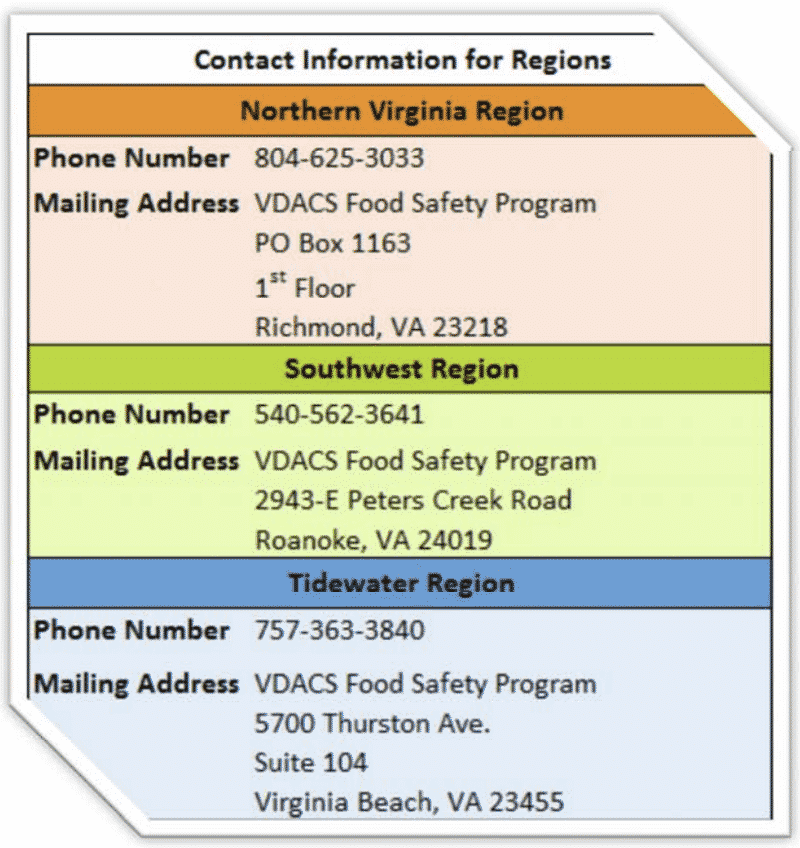
VIRGINIA COTTAGE FOOD CONTACT INFO
Regional Contact Info (Regional Map Here)
UPDATES TO VIRGINIA COTTAGE FOOD LAWS
From time to time, links, info, rules and numbers change, are updated or made obsolete.
Although I spend time daily with hundreds of vendors (many of which are cottage food businesses) – I can miss an update.
If you find a broken link or outdated state information… please let me know and I’ll send you a special thank you for helping me maintain the best site on the internet for the cottage food industry.
My goal has always been to have a central place that is absolutely free for those starting out or existing entrepreneurs who use their homes and kitchens to make real incomes.
Please send to [email protected] / or post inside the private VendorsUnited.com group.
Need more resources? Check it out HERE (Helpful Resources)
Take a peek at the best vendors on the planet, the community that rocks the food vending world: Vendors United…
Disclaimer
This information is provided to help those interested in starting a cottage food business. It is not a document made by the state government. This information is not provided as law nor should be construed as law. Always use the contact information for each state to confirm compliance and any changes.
Did we help you? Help us to share this information…
A person on Facebook sells cakes. ( In Virginia) But whenever someone asks the price she says she’s not allowed to say on Facebook but rather they contact her by phone. She says this is because of the Cottage law. Well, I’ve searched that law and can’t find anything regarding advertising of prices. What’s the truth?
What rules apply to cooking/baking professional pre-made dough for sale under cottage industry laws in VA
Info not in the article can be obtained b calling local Health departments. Thank you.