 WATCH VIDEO!
 WATCH VIDEO!
Idaho cottage food laws incorporate some of the best features to encourage entrepreneurship. Idaho is among those states that make it easy to start your own cottage food business.
In March 2026, Idaho signed the Idaho Direct-to-Consumer Commerce Act into law. This is one of the most producer-friendly food laws in the country. It lets you sell both shelf-stable and perishable homemade foods directly to Idaho consumers with very little red tape.
If you’ve been dreaming of turning your kitchen, farm, or ranch into a real income stream, there’s never been a better time to start. Let’s walk through exactly what’s allowed now, step by step.
Table of Contents
HOW TO START YOUR COTTAGE FOOD BUSINESS IN IDAHO – LICENSING
Here’s the encouraging part: under the new law, home food operations do not require a license or permit from the Idaho Department of Health and Welfare, and they are not routinely inspected.
Idaho cottage food laws do not require you to register or do anything other than begin selling. However, they do have rules on what you can and can’t serve.
- Contact your local city or county office and ask whether a general business license is required. Just call the main number and let them know you’re starting a home food business.
- Call the Idaho Department of Revenue to ask about collecting and remitting sales tax. Contact: (208) 334-7660.
- Pick your products from the allowed categories below.
- Make your labels (see the exact required statement in the labeling section).
- Start cooking, marketing, and selling.
Do I Have To File Any Paperwork With The Local Health District?
No. The law preempts stricter local rules for these products. A venue or event organizer can still set its own policies, so it’s worth asking ahead of time. But the state no longer requires a food establishment permit or signed risk assessment to sell qualifying homemade foods.
IDAHO COTTAGE FOOD LAW – Foods That Are Allowed
As of March 2026, Idaho is no longer a shelf-stable only state. You can sell both shelf-stable (not requiring refrigeration) and perishable homemade foods directly to informed consumers.
Allowed Shelf-Stable Foods (no time or temperature control needed)
- Hermetically sealed butters, jams, jellies, marmalades, preserves, syrups
- Fermented foods
- Tallow and lard
- Fruit leathers, pies, turnovers
- Chocolates, candies, and confections that don’t need refrigeration
- Non-alcoholic drinks that don’t need refrigeration
- Milk and dairy products that don’t need refrigeration
- Nut mixes
- Granola
- Dry soup mixes (excluding meat-based mixes)
- Roasted coffee beans
- Popcorn
- Honey
- Dried, dehydrated, and freeze-dried foods, including jerky products
- Baked goods without frosting or filling made from animal products or other perishable ingredients
Allowed Perishable Foods (that require time or temperature control)
Now, you can sell homemade perishable foods in Idaho. The law defines these as foods that need to be held at 41°F or below for cold foods or 135°F or above for hot foods. Examples include:
- Nonalcoholic drinks like coffee, lemonade, tea, and soda
- Chocolate, candies, and confectioneries
- Condiments and sauces
- Fruits and vegetables that stay uncut after harvest
- Milk and dairy products (subject to dairy compliance)
- Eggs and egg products
- Nut, seed, and fruit butters
- Fresh and dehydrated pastas
- Raw doughs
- Regular and sugar-free butters, jams, jellies, marmalades, preserves, and syrups
- Baked goods with frosting or filling made from animal products or perishable ingredients
- Meat products produced under this chapter (see the meat rules below)
- Cooked vegetables
- Pickled products
What If My Food Product Isn’t On The Approved List?
The list of approved foods is only a partial list. You are allowed to sell other foods as long as you have them tested at a certified lab. (see Acidity testing below for more info)
Real Life Cottage Food Entrepreneurs and Opportunities
- Cakes – teacher turns kitchen into bakery
- Doughnuts – cottage mini donut vendor
- Fruit jams and jellies – See Additional Requirements Here
- Kettle corn – real kettle corn vendors from home
- Popcorn (plain and flavored) – see a real home vendor here
- Talk and Join hundreds of others here: VendorsUnited.com
IDAHO COTTAGE FOOD LAWS – PROHIBITED FOODS
The new law is broad, but it isn’t a free-for-all. A few important boundaries apply:
- On-site, ready-to-eat food service is not covered. “Homemade” does not include food prepared, cooked, or served on-site for immediate consumption. That means no restaurant-style service, mobile food units, concession trailers, or facilities making ready-to-eat meals under this law.
- Milk and dairy products may only be sold if the producer or designated agent fully complies with Idaho’s applicable dairy chapters (Chapters 3, 4, 5, and 12 of Title 37).
- Raw milk and raw milk products require full compliance with Idaho’s raw milk chapter (Chapter 11, Title 37).
- Products can’t be used as ingredients in a licensed food establishment, including public school kitchens.
- Meat sales are limited to specific exceptions (covered in the meat section below).
HOW MUCH ARE YOU ALLOWED TO MAKE WITH COTTAGE FOODS IN IDAHO?
Idaho does not have a limit on annual sales like many states, this means you can make as much as you want while you save up to expand into a commercial retail business. The one thing to keep in mind is who you’re selling to and where. All sales must be direct to an informed end consumer and must stay entirely within Idaho (more on that in the sales sections below).
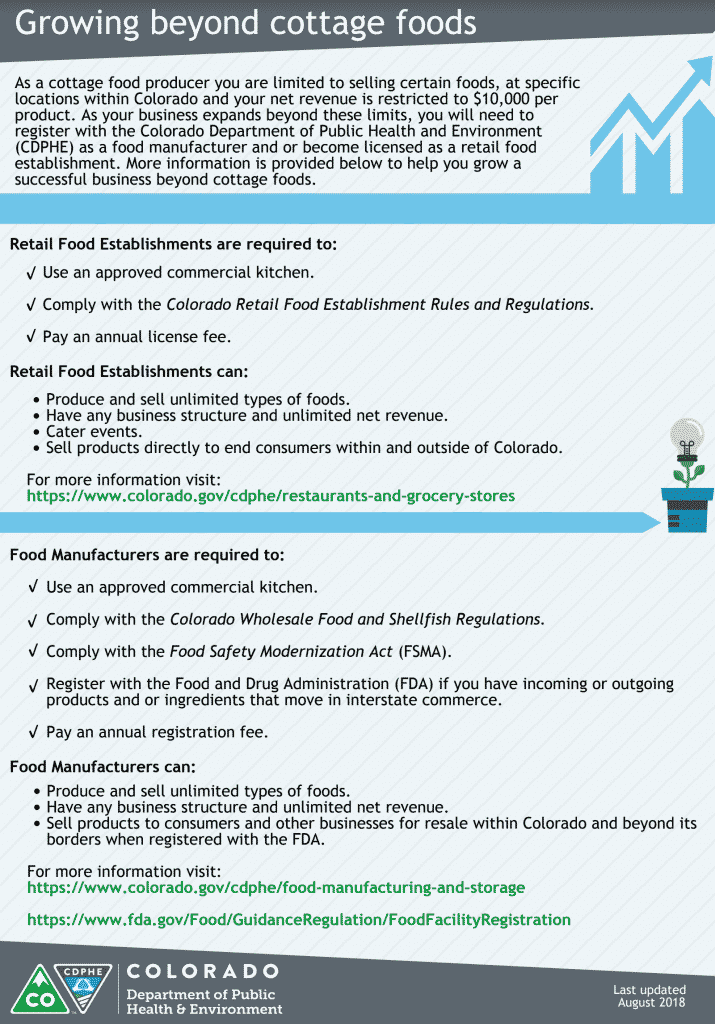
Colorado created a brochure on going beyond cottage food once you’ve outgrown or hit your maximum allowed income.
ACIDITY LEVELS AND TESTING
Most states determine if a food is non-potentially hazardous by the acidity level found in the food. The higher the acidity, the more stable at a range of temps, that food product is.
For example: milk is low acidity and requires temperature controls.
The acidity of foods is measured by pH.
• The range of pH is commonly considered to extend from zero to 14. A pH value of 7 is neutral because pure water has a pH value of exactly 7. Values less than 7 are considered acidic, while those greater than 7 are considered basic or alkaline.
• All fruits are acidic foods and are usually tart and sour. Ex: tomato, lemon, peach, apple, etc.
• The FDA rule for acidic foods states that a food must have a pH below 4.6 to be sold as a minimally processed food.
• The reason for this is bacteria does not grow at this level of acidity.
• The exclusion shall not be construed as allowing the sale of low acid foods (pH > 4.6) in
hermetically sealed containers (i.e. home-canned green beans, peas, etc.) when such
food is not prepared in a permitted establishment.
TESTING
Some states require testing if the pH level is unknown. For many food products, the pH level is already known.
You can test for pH yourself using a pH spear tester. (make sure it is made for food and has a long spear tip).
Oklahoma State University shares an awesome guide for selecting the correct tester for foods and liquids which includes tips and tricks for operation and maintenance. Get The Guide Here.
IDAHO COTTAGE FOOD LAWS LABELING REQUIREMENTS
The new law is specific about what your label, sign, or card must say. You must provide a conspicuously displayed sign, a label affixed to the product, or a card given to the consumer that includes all three of the following:
- This exact statement:
“This product is not subject to government food safety inspection or licensing requirements. It may contain allergens.”
- Your name and contact information as the producer.
- An ingredient list, if the product contains two or more ingredients.
For perishable foods, you must also include handling instructions that tell the customer how to store and prepare the product safely. That’s not just good manners — it’s part of the law.
Using VistaPrint or a similar service, you can quickly create clean, professional labels that meet the requirements and double as marketing for your brand.
Using VistaPrint.com or similar – you can quickly create professional labels that not only serve to meet the state cottage food guidelines but also serve for marketing your awesome business and products.
You’ll find some fantastic examples of this from members inside VendorsUnited.com
ALLERGENS ON LABELING
The FDA lists nine (9) major food allergens. Listing any of these on your label is a smart business practice and will certainly help your customers choose a product.
- Milk
- Eggs
- Fish (e.g., bass, flounder, cod)
- Crustacean shellfish (e.g., crab, lobster, shrimp)
- Tree nuts (e.g., almonds, walnuts, pecans)
- Peanuts
- Wheat
- Soybeans
- Sesame seeds
Simply add to your label: “NOTICE: SOYBEANS USED IN THIS RECIPE” Some go as far to announce that a certain allergen is used in the same kitchen.
Some states require you list any potential allergens and potential for any cross contamination even if the allergen is not used in the recipe.
FDA Allergen Labeling Example: Contains Wheat, Milk, Egg, and Soy
A Word on Meat, Poultry, Fish, and Eggs
The law generally doesn’t cover the sale of meat, with specific exceptions. You may sell:
- Poultry and poultry products from your own raising, if you slaughter no more than 1,000 birds per year, only sell what you raise, and the product isn’t adulterated or misbranded
- Live animals and portions of live animals (including through animal shares before slaughter)
- Domestic rabbit meat
- Farm-raised fish, as long as it’s raised per Idaho Code and isn’t catfish
- Meat from cattle, sheep, swine, and goats that has been inspected by the USDA or another approved inspector
Animal shares deserve a special mention. If a consumer buys an ownership interest in an animal or herd before slaughter (through a written contract or bill of sale), receiving their share of meat isn’t treated as a meat “sale.” The meat must be delivered within Idaho, the packaging must be labeled “not for sale,” and the consumer can’t resell or donate it.
WHERE CAN I SELL MY COTTAGE FOOD PRODUCTS
Idaho Cottage Food Laws – Sales Rules
You have real flexibility here. You may sell your products from your residence, farm, ranch, or farm stand directly to the consumer, and you’re allowed to sell at just about any venue as long as the sale reaches an informed end consumer.
Possible venues include:
- Farmers’ markets
- Roadside stands and farm stands
- Your home
- The internet
- Mail order and delivery within Idaho
The One Big Rule: Keep It Inside Idaho
Every part of the transaction must happen wholly within the state of Idaho. That means production, processing, packaging, sale, and delivery all take place in-state, and the sale must not involve interstate commerce.
So here’s the clean summary:
❌ Selling or shipping across state lines: not allowed
✅ Online sales within Idaho: allowed
✅ Mail order and delivery within Idaho: allowed
Third Party Sales
The old rule essentially required you to become a permitted commercial kitchen to sell through anyone else. The new law opens things up considerably.
Designated Agents
You may now name a designated agent to help facilitate your sales. A designated agent can be a person, a cooperative market, a consignment-model market, or another entity, and they may handle:
- Marketing
- Transport
- Storage
- Selling
- Delivery
The key limit: a designated agent must be named in writing by you, and they may not take ownership of your food or drink products. You stay the producer; they help you reach customers.
Retail Spaces
Qualifying products can also appear in retail settings, even one tied to a commercial food establishment. But the space must play by two rules:
- Physically separate these products from other products — including separate shelving in coolers, freezers, warehouses, and storage areas.
- Post clear signs or markings showing which area offers products sold under this law.
That separation and signage protect consumers and keep your products clearly identified.
Can I Sell Online, Craigslist, Facebook, Etc.?
Yes — as long as the buyer is an informed end consumer and the entire transaction stays within Idaho.
You can market and sell through your website, social media, online marketplaces, and community pages. You can take orders online and deliver or mail products inside Idaho. Just remember the golden rule: no interstate sales, and no reselling by the buyer.
Inside kitchenincome.com you can find out how many cottage food entrepreneurs are getting sales faster than they can make the food.
FOOD HANDLER TRAINING AND BEST PRACTICES
Idaho does not require you to complete a food safety or handler course to sell under this law. Still, knowing safe handling practices protects both you and your customers, and the state’s Department of Health and Welfare compiles free educational material on food safety and safe storage that’s worth reviewing.
There are many short courses you can take online and actually get certified and be able to share that with your customers.
Many of our VendorsUnited.com members are proud to display their food safety certificates as a way to insure their customers that they care. This helps your business.
- Short courses that provide food handling and safety certification
- Free info from the FDA – food safety
SAFE PRACTICES
Much of this may seem like common sense, but even if you already know, it’s a good idea to remind yourself with a list of things that can prevent you from missing something small.
And if for no other reason… CYA! CYA = Cover Your A#%
CLEAN WORK AREA / WORK SPACE / SANITIZATION
Providing safe to eat foods from your kitchen – starts in your kitchen.
Keep your area clean and sanitized to avoid cross contamination and to insure you provide your customers and clients with the safest and best foods they can get.
The following are some “common” sense things you can do to insure the best environment for preparing foods to sell:
- Keep all equipment and surface areas clean and sanitized
- Make sure window and door screens are bug proof with no gaps
- Keep ingredients separate to prevent cross contamination / e.g. raw eggs near flour
- No pets in work area and preferably none in the home
- Allow no-one with a cold, sniffles or sick in kitchen while preparing foods
- Wipe down walls and clean floors daily
- Use good lighting to avoid missing unclean areas
- Keep window and door screens in good repair to keep insects out
- Wash hands frequently while working and use food grade gloves for extra safety
- Keep areas of food storage and equipment storage clean and sanitized
Handling Perishable Foods
Because perishable foods are now allowed, safe temperature control matters more than ever. The law requires that perishable food be produced, processed, stored, transported, and sold under conditions reasonably intended to maintain its safety and integrity — and that you provide handling instructions to your customer. Keep cold foods cold, hot foods hot, and put those storage tips right on the label.
RECORD KEEPING
Here’s a change you’ll want to take seriously: recordkeeping is no longer just a best practice — it’s a legal requirement.
Under the new law, you (or your designated agent) must keep transaction records that identify:
- The type and quantity of product sold
- The date of sale
- The date of production
- Where the homemade food was produced
- Where each ingredient was produced or acquired
A few key details:
- Records must be retained for at least two (2) years from the date on the record.
- If you use a designated agent, name that agent in the records for each transaction they handled.
- For animal shares, keep the written contract or bill of sale as your record.
- Your records are confidential and generally can’t be handed over to any state agency, political subdivision, or health district — except during a confirmed foodborne illness investigation.
- There’s no routine reporting or inspection of records outside such an investigation.
- If a foodborne illness investigation finds you didn’t keep the required records, you could face a fine of up to $500.
A simple notebook or spreadsheet works fine. Keep it consistent, and you’ll be protected if a question ever comes up.
💡 Why this matters: Imagine someone claims your banana bread made them sick. Good records let you show exactly what you made, when you made it, and where each ingredient came from. That’s peace of mind worth a few minutes a day.
COTTAGE FOOD lIABILITY INSURANCE
We live in a society that likes to sue. I can sue you for wearing that color shirt. No kidding! Of course I probably won’t win, but at the very least, it’s gonna cause you stress and some costs.
Liability insurance is a MUST.
It can be expensive – but several years ago, I found FLIP and by far, they gave me the most protection (coverage) and allow you to run your cottage food business without fear of being sued.
WHY? Because they provide the lawyers. And their lawyers… they are good!
Of course you should price shop around with your local agent or a national brand company, but rest assured, I’ve done all the legwork for you.
Alternatively, some folks opt to get bonded. You’ve heard the saying before: “licensed and bonded”. A bond is usually provided from an insurance bonding company or your own insurance company.
My first time, I got a bond at State Farm.
A bond is expensive comparatively but is less out of pocket in the beginning. Of course, it’s way, way less insurance / coverage too.
A $10,000 bond may cost $50 annually while a $2,000,000.00 liability policy may cost a few hundred a year.
No matter what you decide… knowing you’re insured against frivolous lawsuits is worth every penny.
IDAHO COTTAGE FOOD LAWS QUESTIONS AND ANSWERS
- Do I need a license or permit?
- No. Home food operations under this law don’t require a state license, permit, or routine inspection.
- Can I sell perishable foods now?
- Yes. This is one of the biggest changes. Both shelf-stable and perishable foods are allowed, including pickled products, cooked vegetables, eggs, and frosted or filled baked goods.
- Can I ship out of state?
- No. Every part of the transaction must stay within Idaho. No interstate commerce.
- Can someone else sell for me?
- Yes, through a written designated-agent arrangement. Your agent can market, transport, store, sell, and deliver, but can’t take ownership of your products.
- Do I really have to keep records?
- Yes. Recordkeeping is now required, with a two-year retention rule.
- Can a store carry my products?
- Yes, if the retail space physically separates your products from other products and clearly marks the area.
IDAHO COTTAGE FOOD LAWS IMPORTANT LINKS
- Idaho Food Safety rules
- Idaho Food Code informational copy
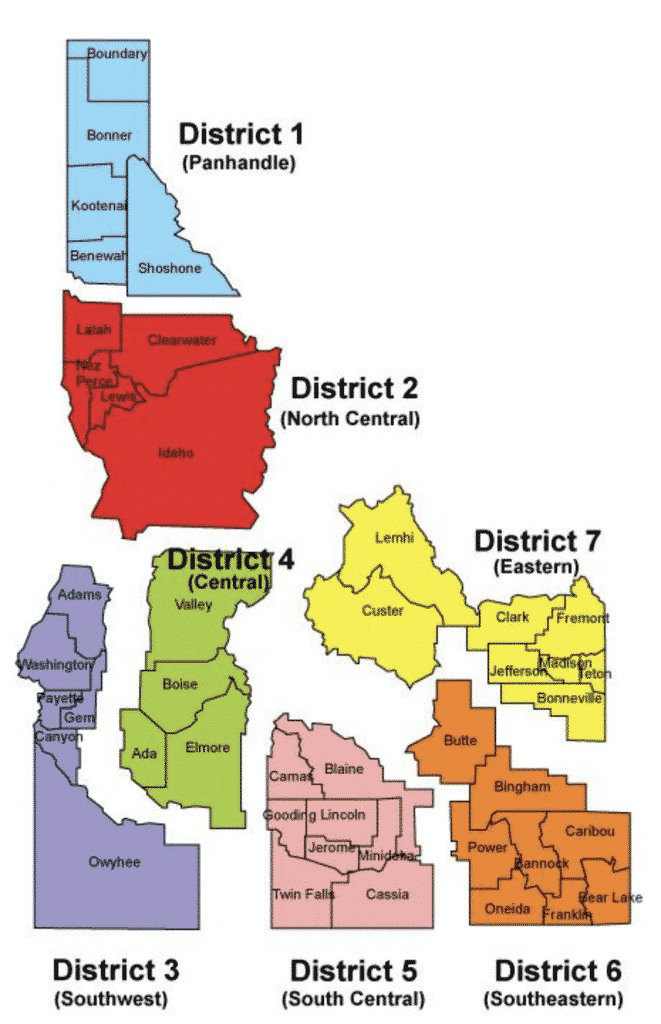
- Idaho Individual Health District Contacts
CONTACT iDAHO HEALTH DISTRICTS
UPDATES TO IDAHO COTTAGE FOOD LAWS
From time to time, links, info, rules and numbers change, are updated or made obsolete.
Although I spend time daily with hundreds of vendors (many of which are cottage food businesses) – I can miss an update.
If you find a broken link or outdated state information… please let me know and I’ll send you a special thank you for helping me maintain the best site on the internet for the cottage food industry.
My goal has always been to have a central place that is absolutely free for those starting out or existing entrepreneurs who use their homes and kitchens to make real incomes.
Please send to [email protected] / or post inside the private VendorsUnited.com group.
Need more resources? Check it out HERE (Helpful Resources)
Take a peek at the best vendors on the planet, the community that rocks the food vending world: Vendors United…

Disclaimer
This information is provided to help those interested in starting a cottage food business. It is not a document made by the state government. This information is not provided as law nor should be construed as law. Always use the contact information for each state to confirm compliance and any changes.
Did we help you? Help us to share this information…